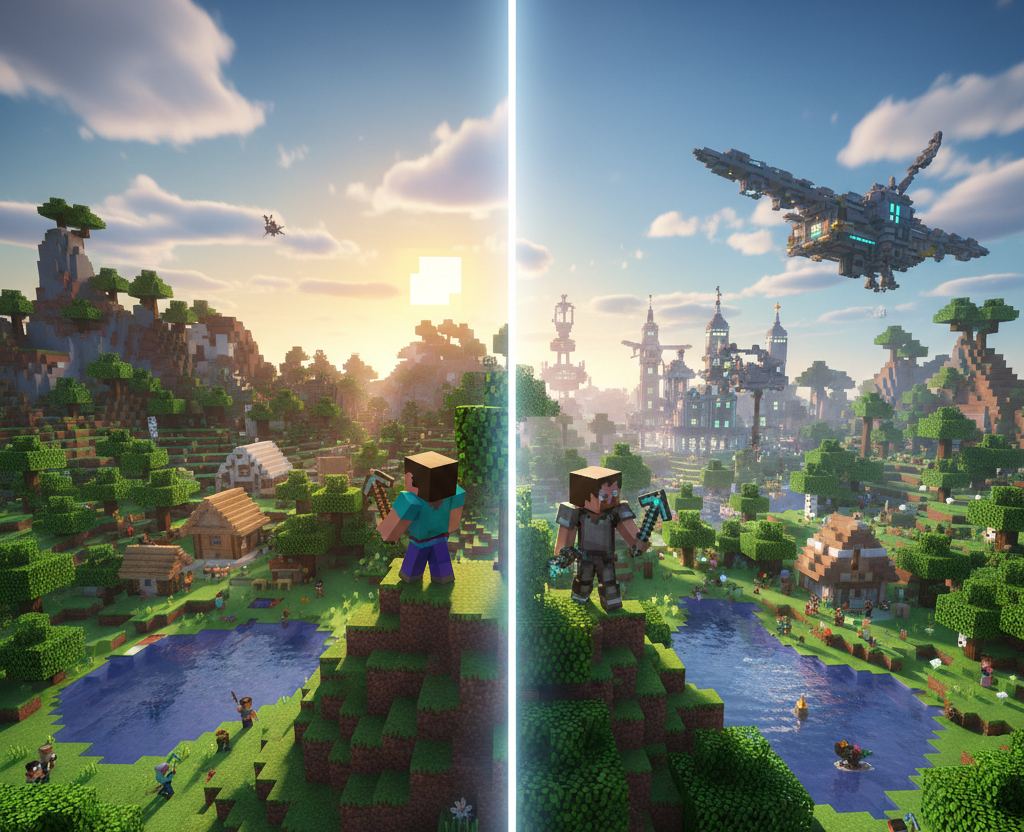
More than fifteen years after its original release, Minecraft continues to dominate conversations across gaming communities. New sandbox titles appear every year, offering advanced graphics, massive worlds, and ambitious systems—yet Minecraft remains unmatched in popularity, longevity, and cultural relevance.
So the question many gamers are asking in 2026 is simple but important: Is Minecraft still the king of sandbox games?
The short answer is yes—but not just because of nostalgia. Minecraft has evolved in ways that few games ever manage, and its influence today is stronger than ever.
A Sandbox That Truly Has No Limits
At its core, Minecraft is still about freedom. Players aren’t told what to do, how to do it, or when to stop. Survival, Creative, Hardcore, Adventure, and Spectator modes give players total control over how they experience the game.
In 2026, this freedom feels more powerful than ever. Modern world generation creates breathtaking landscapes with deeper caves, taller mountains, and more dynamic biomes. Whether you want to survive on a tiny island, build a futuristic city, or recreate real-world landmarks block by block, Minecraft lets you do it without restriction.
Most sandbox games offer tools. Minecraft offers possibility.
Constant Updates Keep the World Fresh
One major reason Minecraft still leads the sandbox genre is its long-term developer support. Instead of releasing sequels, Mojang continues to expand the same universe through meaningful updates.
By 2026, Minecraft includes:
-
Richer biomes and terrain generation
-
Expanded mobs and wildlife behaviors
-
Deeper cave and underground systems
-
Improved building blocks and materials
-
Quality-of-life features players asked for years
These updates don’t change Minecraft’s identity—they strengthen it. Old worlds still feel familiar, but new worlds feel exciting and modern.
Few sandbox games manage to evolve without losing their soul. Minecraft does exactly that.
Creative Mode: Still Unmatched
No discussion about Minecraft’s dominance is complete without talking about Creative Mode. Even in 2026, no sandbox game gives players this level of building freedom with such simple tools.
From massive medieval castles and sci-fi cities to working computers and calculators made from Redstone, the community continues to push what’s possible. Entire games, animations, and interactive experiences are built inside Minecraft itself.
What makes this special is accessibility. You don’t need a degree in design or programming to start creating. Anyone can place a block—and from there, imagination does the rest.
Survival Mode Still Feels Relevant
Survival mode remains one of the most searched and played aspects of Minecraft in 2026. While the core loop is familiar—gather, craft, survive—the experience feels deeper thanks to improved world systems.
Resource management matters more, exploration feels more rewarding, and long-term survival worlds become personal stories rather than short playthroughs. Whether you’re playing solo or with friends, survival still offers that slow, satisfying sense of progress that many modern games rush past.
Minecraft survival doesn’t rely on constant action. It thrives on patience, planning, and creativity.
Multiplayer and Community Power
Minecraft’s multiplayer ecosystem is one of its strongest pillars. In 2026, servers host millions of players daily across survival SMPs, mini-games, roleplay worlds, hardcore challenges, and custom game modes.
What keeps multiplayer alive is variety. One server can feel like a competitive esport, another like a social hangout, and another like a full RPG—all within the same game.
Community-driven content keeps Minecraft fresh without forcing players to buy new titles. Every server offers a new way to experience the game, which is something very few sandbox games can replicate at this scale.
Mods: The Secret Weapon
If Minecraft is still king in 2026, mods are one of the biggest reasons why.
The modding scene remains incredibly active, adding:
-
New dimensions and biomes
-
Advanced machines and automation
-
Magic systems and RPG mechanics
-
Enhanced graphics and shaders
-
Entirely new gameplay loops
Mods allow Minecraft to compete with modern AAA sandbox games without changing its core design. Players can turn Minecraft into a space exploration game, a factory simulator, or a fantasy RPG—all while keeping the familiar blocky foundation.
No other sandbox game has a modding ecosystem this large, stable, and creative.
A Game for Every Age
Another reason Minecraft still dominates is its universal appeal. Kids, teenagers, adults, and even older players all find something meaningful in the game.
Parents appreciate its creativity and problem-solving aspects. Educators use it as a learning tool. Hardcore gamers turn it into a challenge. Casual players use it to relax.
Very few games manage to stay relevant across generations. Minecraft doesn’t just attract new players—it grows with them.
Competition Has Grown, But Minecraft Adapted
It’s true that sandbox competition is stronger than ever in 2026. New games offer advanced physics, realistic visuals, and complex systems. But Minecraft never tried to compete on realism.
Instead, it focused on:
-
Simplicity
-
Creativity
-
Accessibility
-
Community
Minecraft doesn’t need cutting-edge graphics to remain powerful. Its visual style is timeless, instantly recognizable, and endlessly customizable through texture packs and shaders.
While other sandbox games rise and fall, Minecraft remains stable—because it’s built on ideas, not trends.
Cultural Impact Beyond Gaming
Minecraft in 2026 isn’t just a game—it’s a platform. It exists on YouTube, Twitch, schools, online communities, and pop culture as a whole.
Challenges, speedruns, roleplay series, and long-form survival content continue to attract massive audiences. New players often discover Minecraft not through ads, but through creators and friends.
That cultural presence reinforces Minecraft’s dominance. It’s not just played—it’s shared.
So, Is Minecraft Still the King in 2026?
Yes—but not because it’s the newest or flashiest sandbox game.
Minecraft remains king because it offers:
-
Total creative freedom
-
Endless replayability
-
Strong community support
-
Long-term updates instead of sequels
-
A game that adapts without losing identity
It doesn’t try to be everything at once. It simply gives players the tools to make anything.
Final Verdict
In 2026, Minecraft isn’t surviving on nostalgia—it’s thriving on evolution. While many sandbox games compete for attention, Minecraft continues to stand above them by empowering players rather than directing them. Its simplicity, creativity, and community-driven growth ensure that it remains relevant year after year.
As long as players want freedom, imagination, and a world where ideas matter more than objectives, Minecraft will continue to wear the crown.